

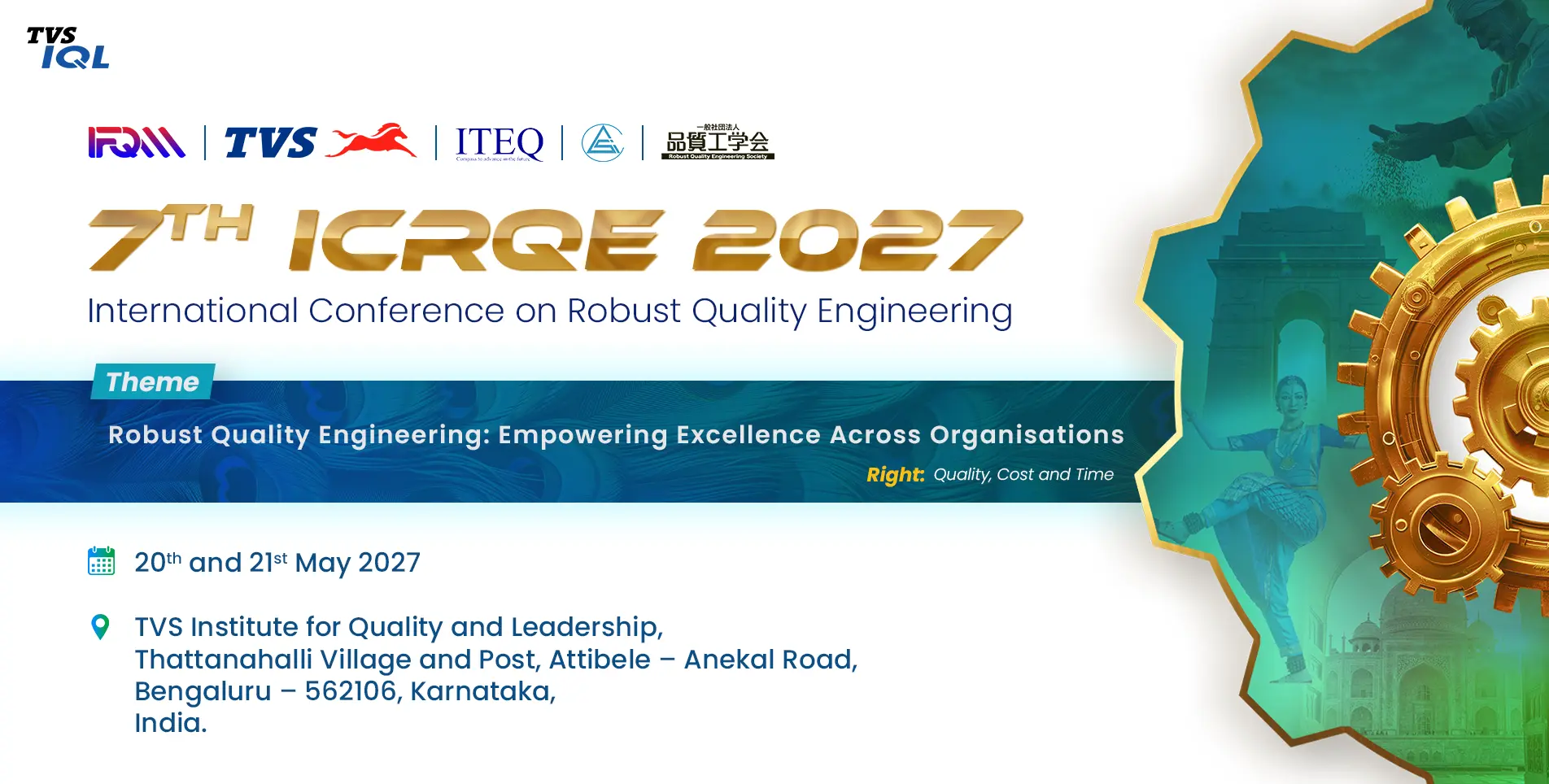
Date: 20th & 21st May 2027
Venue: TVS Institute for Quality and Leadership, TVS Motor Company Thattanahalli Village and Post, Attibele – Anekal Road, Bengaluru – 562106, Karnataka, India
International Conference on Robust Quality Engineering. (ICRQE) is a global conference focused on Robust Quality Engineering (RQE), a discipline built on Dr. Genichi Taguchi’s methods for improving product and process robustness. The conference provides a platform for:
- Sharing case studies and industry applications of Robust Quality Engineering
- Discussing advances in Taguchi Methods
- Exploring topics like robust optimization, Design for Six Sigma, quality tools, tolerance design, and more.
List of ICRQE Conferences Held:
1st ICRQE — 2013, Kuala Lumpur, Malaysia
2nd ICRQE — 2014, Bangalore, India
3rd ICRQE — 2017, Mumbai, India
4th ICRQE — 2018, Kuala Lumpur, Malaysia
5th ICRQE — 2021, Tokyo, Japan (RQES)
6th ICRQE — 2024, Penang, Malaysia
Call for Papers
- ICRQE invites researchers, academicians, industry professionals, practitioners, and innovators from diverse fields to submit original research papers, case studies, and practical applications related to Robust Quality Engineering.
- Submissions are welcome from professionals across engineering, quality, manufacturing, research and development, management, business operations, service industries, healthcare, education, and other fields.
- Papers are encouraged from both engineering and non-engineering fields where Robust Quality Engineering principles are applied to improve quality, reliability, productivity, efficiency, customer value, and organisationalperformance.
- Papers are invited for consideration by the conference program committee. The technical sessions will run in a several concurrent streams and each session will support subthemes under the main conference theme “Robust Quality Engineering: Empowering Excellence Across Organisations”.
- Papers related to the following paper categories, which may well be sub-themes of the conference in the concurrent session streams, will be most welcome.
Paper Categories
- Robust assessment & optimization
- Pattern recognition using Mahalanobis-Taguchi System (MTS).
- Quality loss function & tolerance design
- System Behavioural Testing (SBT) for system validation
- T-methods for modeling
- Design of Six Signa (DFSS) related topics
Submission Guidelines
- Abstracts must be between 250 and 300 words and include 3 to 5 keywords.
- Papers must present original, unpublished work relevant to Robust Quality Engineering and the topics listed under “Paper Categories.”
- Papers from Japan that have previously been presented in Japanese may be resubmitted and presented in English.
- Submissions may include research findings, industrial case studies, methodological advancements, or practical implementations.
- Submissions should demonstrate a clear connection to robustness, functional stability, variability reduction, or methodologies associated with Robust Quality Engineering.
- Detailed formatting guidelines and templates for full paper, posters, and videos will be made available on the official conference website at a later stage.
- Preferred conference languages are English, Japanese, and Chinese. Translation support will be provided where required.
Timelines
- Abstract Submission Opens – From September 2026
- Abstract Submission Deadline – 28th February 2026
- Notification of Abstract Acceptance – Within two weeks of abstract submission
- Full Paper Submission Opens – 15th January 2027
- Final Full Paper Submission Deadline – 31st March 2027
- Video submission – 30th April 2027
- Pre Conference Dates – 19th May 2027
- Conference Date – 20th & 21st May 2027
Authors will be notified of the acceptance status of their abstracts within two weeks of submission. The Full Paper Submission portal will be accessible after the abstract acceptance decision has been communicated to the authors.
It is recommended to submit your abstract at the earliest, so you have plenty of time to prepare for travel.
Steps to Submit Your Paper
- Click the submission link provided to submit your abstract/paper for ICRQE 2027.
- New authors/participants are required to create an account on the EasyChair portal before proceeding with the submission.
- Existing EasyChair users can log in using their credentials and follow the submission process to upload their abstract/paper.
Important Note:
- Creating (or having) an EasyChair account is mandatory for all authors to submit and manage their papers
- Call for Abstracts is open until 28 February 2027. Authors will be notified of the acceptance status of their abstracts within two weeks of submission. The Full Paper Submission portal will be accessible after the abstract acceptance decision has been communicated to the authors.
It is recommended to submit your abstract at the earliest, so you have plenty of time to prepare for travel.
Download the Call for Papers Brochure to explore submission guidelines, and important timelines. Click here to access the brochure.
Review Process Flow
Copyright Policy
- Authors retain the copyright of their submitted work, while granting ICRQE the right to publish, distribute, and archive accepted papers, abstracts, and presentation materials as part of the conference proceedings.
- Accepted papers will be included in the official ICRQE proceedings circulated to delegates and participants.
- Authors are free to submit their work to other journals, conferences, or publication channels.
- Prior permission from ICRQE must be obtained before republishing the same work elsewhere.
- Authors must ensure that all submitted content is original and does not infringe on any third-party intellectual property rights.
- Additional publication and copyright-related details, if any, will be communicated by the Organizing Committee at a later stage.
Program Agenda
| ICRQE Conference 2027 - Program Agenda (Tentative) | ||
|---|---|---|
| Date | Agenda | Time (IST- Zone) |
| 19th May 2027 | Taguchi Methods Made Simple: An Introductory Seminar for Beginners by Mr. Shin Taguchi | 11:00 AM - 17:00 PM |
| Topic: Concept and application of Robust Optimization | 11:00 AM - 12:30 PM | |
| Topic: Concept and application of Mahalanobis-Taguchi System (MTS) | 13:30 PM - 15:00 PM | |
| Topic: Concept and application of System Behavior Testing (SBT) | 15:30 PM - 17:00 PM | |
| 20th May 2027 | Lighting the lamp and Invocation | 10:00 AM - 17:30 PM |
| Welcome and Keynote address | ||
| Special presentation 1 - TVSM Journey on Taguchi methods CoP & Business impact | ||
| Special presentation 2 - IFQM Journey on Taguchi methods | ||
| Address by Chief Guest | ||
| Paper presentations | ||
| Poster presentations | ||
| Panel discussion | ||
| Gala Dinner + Networking | 18:30 PM - 20:00 PM | |
| 21st May 2027 | Welcome & Keynote Address | 09:30 AM - 17:30 PM |
| Paper presentations | ||
| Poster presentations | ||
| Case study presentation | ||
| Roundtable Discussion (Topic + Q&A) | ||
| Reward & recognition | ||
| Reflection & Conclusion | ||
19th May 2027
20th May 2027
21st May 2027
Registration Fee
| Category | Per Person Cost (INR) | USD |
|---|---|---|
| Local Researcher/Presenter (Individual) | 20,000 | 200 |
| International Researcher/Presenter (Physical) | 25,000 | 260 |
| International Researcher/Presenter (Virtual) | 20,000 | 200 |
| Local Participant (Physical) | 10,000 | 150 |
| Local Participant (Online) | 7,000 | 100 |
| International Participant (Physical) | 20,000 | 200 |
| International Participant (Online) | 10,000 | 100 |
| Industry Participant | 25,000 | 280 |
| Academic Participant | 10,000 | 250 |
| Pre-Conference Introductory Seminar (Physical) - 3 Classes | 30,000 | 200 |
| Pre-Conference Introductory Seminar (Physical) + Presenter - 3 Classes | 25,000 | 275 |
| Pre-Conference Introductory Seminar (Virtual) - 3 Classes | 20,000 | 200 |
| Pre-Conference Introductory Seminar (Virtual) + Presenter - 3 Classes | 15,000 | 150 |
| Pre-Conference Introductory Seminar (Physical) - 2 Classes | 20,000 | 200 |
| Pre-Conference Introductory Seminar (Physical) + Presenter - 2 Classes | 15,000 | 175 |
| Pre-Conference Introductory Seminar (Virtual) - 2 Classes | 14,000 | 150 |
| Pre-Conference Introductory Seminar (Virtual) + Presenter - 2 Classes | 12,000 | 125 |
| Pre-Conference Introductory Seminar (Physical) - 1 Class | 13,000 | 130 |
| Pre-Conference Introductory Seminar (Physical) + Presenter - 1 Class | 10,000 | 100 |
| Pre-Conference Introductory Seminar (Virtual) - 1 Class | 9,000 | 80 |
| Pre-Conference Introductory Seminar (Virtual) + Presenter - 1 Class | 7,000 | 75 |
Important Note:
- TVSM Participants (first 120 members) - Free
- Early bird discount (10%)
- IFQM members - Discount (30%)
- RQES members - Discount (30%)
- Student discount (50%)
- MSME discount (30%)
Important Note:
- TVSM Participants (first 120 members) - Free
- Early bird discount (10%)
- IFQM members - Discount (30%)
- RQES members - Discount (30%)
- Student discount (50%)
- MSME discount (30%)
Local Researcher/Presenter (Individual)
International Researcher/Presenter (Physical)
International Researcher/Presenter (Virtual)
Local Participant (Physical)
Local Participant (Online)
International Participant (Physical)
International Participant (Online)
Industry Participant
Academic Participant
Pre-Conference Introductory Seminar (Physical) - 3 Classes
Pre-Conference Introductory Seminar (Physical) + Presenter - 3 Classes
Pre-Conference Introductory Seminar (Virtual) - 3 Classes
Pre-Conference Introductory Seminar (Virtual) + Presenter - 3 Classes
Pre-Conference Introductory Seminar (Physical) - 2 Classes
Pre-Conference Introductory Seminar (Physical) + Presenter - 2 Classes
Pre-Conference Introductory Seminar (Virtual) - 2 Classes
Pre-Conference Introductory Seminar (Virtual) + Presenter - 2 Classes
Pre-Conference Introductory Seminar (Physical) - 1 Class
Pre-Conference Introductory Seminar (Physical) + Presenter - 1 Class
Pre-Conference Introductory Seminar (Virtual) - 1 Class
Pre-Conference Introductory Seminar (Virtual) + Presenter - 1 Class
Registration Fee Includes:
- Tea and Snacks (Masterclass + Conference days)
- Special lunch (Conference days)
- Gala Dinner on 20 May 2027 from 7:30 PM IST
- Thesis review fees
- Visa application document preparation fees
Cancellation Policy:
- Cancellations made on or before 30 March 2027: 80% refund of the registration fee.
- Cancellations made between 31 March 2027 and 30 April 2027: 50% refund of the registration fee.
- No refunds will be provided for cancellations made after 30 April 2027.
- All cancellation requests must be submitted in writing to the organizing committee.
- Refunds, if applicable, will be processed within 30 working days after the event.
Kindly note that the registration fee payment link will be made available on the website after the paper acceptance results are officially announced.
Who Should Attend and Why?
ICRQE 2027 is designed for quality and reliability professionals, engineers, researchers, academicians, industry leaders, and students seeking to advance their knowledge and impact in the field.
Why Attend?
- Learn from leading experts in Robust and Quality Engineering.
- Explore the latest research, tools, and industry best practices.
- Network with professionals, researchers, and decision-makers from around the world.
- Present your work and gain valuable feedback.
- Discover practical solutions to improve products, processes, and business performance.
- Build your foundation in quality engineering through specialized sessions such as “Taguchi Methods Made Simple.”
Whether you are an experienced practitioner or a beginner, ICRQE 2027 offers a valuable platform to learn, collaborate, and innovate.
Submission & Registration
Registration fee submission details will be shared in the later stage.
For any query or concerns please reach out –
Soumyab@tvsmotor.com – Soumya S Bankapur– IQL,TVSM, India
ICRQE2027@tvsmotor.com – ICRQE2027
rajendran.s@ifqm.org.in – Rajendran – IFQM, India